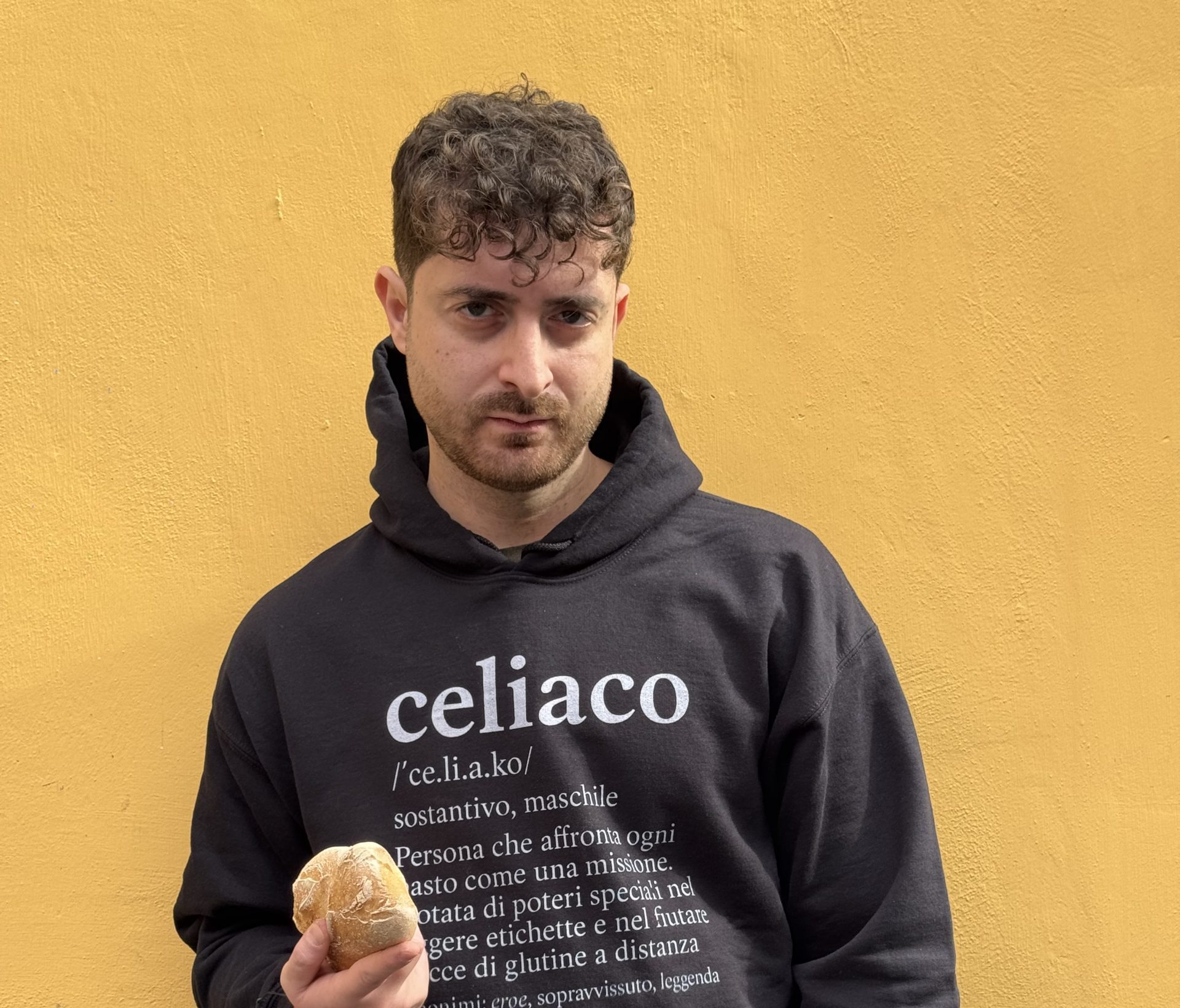
Some stories are born out of indignation, but they don’t stop at the anger of the moment. They use it as a lens to observe the world more clearly. Antonio, the voice behind Il Celiaco Indignato (The Indignant Coeliac), has chosen irony as his language and everyday observation as his tool, turning coeliac disease into a point of view capable of dismantling knee-jerk reactions and clichés.
In his account, irony also becomes a way to dig deeper: into social dynamics, psychological reflexes and those silent tensions that come with daily life for anyone who is coeliac — well beyond the plate.
Between growing awareness, a shifting culture and an eyebrow always ready to rise, this interview is an invitation to look at coeliac disease with a little less superficiality and a little more attention.
Because sometimes getting indignant isn’t losing your cool — it’s beginning to understand.
Watch the interview video1. Let’s start with the origin of the indignation: when did coeliac disease enter your life, and what led you to reframe it with your ironic, sharp storytelling style?
Hi everyone, this is Antonio, though you probably know me as the Indignant One — Il Celiaco Indignato, the Indignant Coeliac. A quick note first: in this interview I’ll be speaking in the first person and not in the third, as I usually do to play the character of the Indignant One.
As for coeliac disease and the origin of my indignation: I’m coeliac, and I found out in 2019, though I’ve probably had it since I was a teenager. I say this because I’m almost asymptomatic, but ever since adolescence I’d had issues like sharp abdominal pains, skin problems, weight loss, vomiting and similar things, which were always blamed on other causes and never on coeliac disease.
In 2019, since I also have psoriasis and vitiligo, my dermatologist had me do some further tests because, in her view, when two autoimmune diseases are present there’s a good chance there’s a third — like coeliac disease, lactose intolerance or Hashimoto’s thyroiditis. I did the tests and, let’s say, I hit the jackpot: all three came back positive.
That’s where my life as a coeliac began. The indignation, though, was born almost a year later. It was the height of Covid: red zone, curfew, you couldn’t go out. To pass the time, on top of opening other pages, I started to think back over a series of situations I’d lived through, things that had happened to me and that fuelled in me the need to have my say, to talk about the things that, in my opinion, weren’t working.
The ironic, sharp style came about once I realised that there are worse things in life, that coeliac disease won’t kill you, but that it’s above all a social problem. So I always try to take it all with irony and lightness. And yet there are still situations that, despite everything, make you angry and indignant all the same.
2. In the early days, what was the situation that made you most indignant of all?
One of the things that made me most indignant at the start was an inner suffering tied to something external. Since I found out I was coeliac, I’ve never had problems of any kind at home.
Of course the family had to be taught: my mum, who did the cooking, my dad, but I too had to learn, just like the rest of the family, to watch out for crumbs, cross-contamination and all of that. But at home I’ve always felt safe, also because we live in a fortunate moment in history when, for gluten-free, there’s truly everything you could want, especially for managing things at home.
What made me suffer and feel most indignant was no longer being able to eat out in a carefree, relaxed way. That was the thing that made me angriest. I remember that a few months after my diagnosis I went on holiday to a province in Puglia and there was nothing: no gluten-free venues, nobody who knew what coeliac disease or gluten-free even was.
While my friends ate out, I was forced to go home hungry and cook for myself. That was certainly something to be indignant about, but also very sad, because coeliac disease is disabling above all on a social level. Not being able to share a lovely moment with friends, especially in summer, really hurts. It’s one of the things that, right from the start, I’ve never been able to tolerate.
3. Is there an episode that truly made you understand what it means to live as a coeliac — one of those you’d now tell with your sense of irony?
More than a single episode, it’s a situation that comes up often, and it’s one of the first things I talked about: the coeliac seems destined to go without dessert.
I remember a ceremony — I think it was a wedding. During lunch there’d been an alternative gluten-free menu, a pretty good one too. But when it came to the dessert, while everyone enjoyed their pudding, the coeliac was handed fruit.
At first it can seem sad, but then it becomes almost comic, because you can’t work out why, in certain restaurateurs’ minds, fruit has to be the equivalent of dessert for a coeliac. It often happens that the ceremony serves fruit and then the dessert, while the coeliac is given a double portion of fruit. It seems like a nice gesture, but really it isn’t at all.
4. In your typical day, what’s the moment when coeliac disease makes your “indignant eyebrow” rise more than usual?
The moment my eyebrow rises the most is the one you don’t expect, because it ought to be your safe place: home. For a coeliac, though, the risk is always just around the corner.
Within the family, especially when there are people who eat gluten, that alarm automatically goes off, the one that has you checking for crumbs and cross-contamination. There are still trivial mistakes, little slip-ups, automatic gestures that could put the coeliac at risk but that just don’t really sink in.
So there’s that irritation of always having to repeat the same things, even after their importance has already been stressed. And that’s when you find yourself with that look on your face that says: “Let’s see what happens today, too.”
5. Eating out can be a minefield: how do you handle it, and what strategies have you developed over time?
Eating out is a very sad subject for me. I’ve always loved going out, travelling, taking a trip out of town and stopping at a restaurant saying: “I reckon the food here is good, let’s go.” For a coeliac, that’s something you can’t do anymore, and it’s sorely missed.
In my view one of the most critical aspects of being coeliac is precisely the lack of calm and serenity that comes from knowing you’ll find something to eat wherever you go. These days it’s all strategy and planning: working out where you’re going, which restaurants there are, whether they have gluten-free options and whether they guarantee no cross-contamination.
Sometimes you also have to weigh up the surcharge, which in some cases is enormous and not always justified by the quality. By now, if I know I have to go to a city or a specific place, I look into it through other creators, on social media or on Google, using keywords like “city name gluten-free”. I check reviews, TripAdvisor and, if needed, I take one last step by speaking directly with the restaurateur.
Compared with the life of a non-coeliac, there’s definitely a lot more strategy and planning involved.
6. Since you’ve taken your perspective on coeliac disease online, have you noticed any progress in food inclusivity?
There are always reasons to be indignant, but the goal of my page is to reach a point where there’s nothing left to be indignant about. At that point I’ll say goodbye to everyone and enjoy my life as a coeliac, maybe turning the project into something else.
The goal is to live a serene life, on a par with non-coeliacs. That said, yes, the situation has improved enormously. In these six years of activity many things have changed — not thanks to me alone, but thanks to the work of all of us creators: the media blitz, the dialogue with restaurateurs and industry experts has shed light on many issues.
Sometimes I even struggle to find something to be indignant about, but then indignation is always just around the corner. The important thing is that, over time, the occasions keep getting fewer.
7. What’s the misconception about coeliac disease that sends you into “regulation-issue indignant” mode most often?
Definitely everything to do with symptoms, slip-ups and cross-contamination. I talk about it because I live it firsthand.
Being almost asymptomatic, people often assume from the outside that, since you have no obvious symptoms, you can let your guard down: have a little slip, not worry too much about cross-contamination, because “nothing happens anyway.” It’s as if there were this idea of a more “easy-going” coeliac.
In reality people don’t understand that, regardless of symptoms, the internal damage is always there. Whether I feel fine or another person feels ill after a crumb of bread, the immune system activates all the same and the gut suffers damage.
There’s no such thing as “less gluten does less harm.” The immune system activates the moment gluten enters the body. I may be asymptomatic or symptomatic, but for my body the damage is always there.
This is something many people don’t grasp, and it leads to careless behaviour, especially in handling gluten-free food — often with no ill intent, but out of a lack of awareness.
8. Even indignant coeliacs have a comfort food or a safe place: what’s yours?
Even indignant coeliacs have a comfort food and a safe place. Mine, as my followers know, is anything to do with tubers: potatoes, chips, fried food in general, sandwiches, pizzas. In short, everything that falls under street food, the so-called “junk food,” in inverted commas.
Over the years I’ve found loads of safe places where I eat in total peace, without worrying about cross-contamination or getting ill. They’re places where, as I often say, indignation stays outside the door.
And then there’s my home. Despite those indignant-eyebrow moments, these days there’s truly everything you need for managing things at home. When you’re coeliac and there’s care toward you, even in the small gestures, at home you can really do anything and feel safe.
9. If you could speak to your past self, what indignant (but useful) truth would you tell him about coeliac disease?
More than an indignant truth, I’d talk about a truth tied to cultural misinformation. In Italy the Mediterranean diet is heavily based on grain, wheat, type 00 flour: pasta, pizza, bread.
We grew up with the idea that “with gluten it’s good, without gluten it’s not good.” That gluten-free food is flavourless or made with who-knows-what. This idea is passed on to everyone, coeliacs and non-coeliacs alike.
Over the years, travelling and trying so many places, I can say with certainty that it’s not like that. Gluten-free can be good. I say this as someone who remembers the flavours of glutenous products and who constantly compares them with those memories.
There are excellent gluten-free products, just as there are glutenous products that don’t measure up. So I’d tell my past self that gluten-free can be good too, because there are people who study, experiment and put their heart and soul into it.
Being coeliac also means giving up certain traditions, but that doesn’t mean you can’t create new ones.
10. Looking at the gluten-free community, what energises you the most today?
What gives me energy is seeing that more and more people are understanding the situation, and that this awareness is reaching everywhere, even into venues. Coeliac disease is increasingly widespread, partly because there are many cases still undiagnosed.
Seeing more and more venues adapting and offering gluten-free options is encouraging. A simple example: today many pizzerias open straight away with a dedicated gluten-free oven, something unthinkable years ago.
This doesn’t mean the work is done: there’s still a lot to do and many issues to resolve. But we’re optimistic.
Coeliac disease won’t kill you, but you do risk dying socially, because there are situations that put you on the spot and make you feel guilty. When you go out, though, it should be everyone’s right to enjoy a dinner, a lunch, a sandwich with friends, a partner or family, leaving the indignation at home.
Conclusion
If you’d like to support my mission and the things I’m working on, I invite you to follow me on Instagram and on the other social platforms I’m on, so you can stay up to date on the projects and the latest news.
Thank you so much, and remember: don’t make the Indignant One indignant.
Leave a Reply